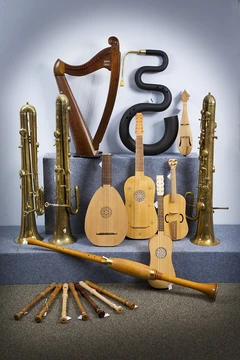
The Mandolin
A plucked lute-family instrument tuned like a violin.

The mandolin is a stringed musical instrument in the lute family, generally plucked with a pick. It most commonly has four courses of doubled strings tuned in unison, giving a total of eight strings, and is tuned in perfect fifths like a violin (G3, D4, A4, E5). As the soprano member of a family that includes the mandola, octave mandolin, mandocello, and mandobass, the mandolin has evolved from earlier lutes and spread worldwide, particularly through the Neapolitan style.
- type
- Stringed musical instrument
- family
- Lute family
- common tuning
- G3–D4–A4–E5 (same as violin)
- common string count
- 8 strings (4 courses of doubled strings)
- most common string material
- Steel strings
- most common types
- Neapolitan (round-backed), archtop (carved-top), flat-backed
Lore & Background
Design variations have included different numbers of strings, such as four-string models (Brescian and Cremonese), six-string types (Milanese, Lombard, Sicilian), six-course instruments of 12 strings (Genoese), and the tricordia with four triple-string courses. Amplification techniques include mandolin-banjo hybrids, resonator mandolins (by Dobro and National String Instrument Corporation), and electric mandolins.
Reader's Guide
The mandolin's significance lies in its role as a versatile soprano instrument in both classical and folk music traditions. Its three most common types—Neapolitan, archtop, and flat-backed—each produce distinct sound qualities and are associated with particular musical styles: Neapolitan mandolins in European classical and Andean music, archtop instruments in American folk, old-time, and bluegrass, and flat-backed instruments in Irish, British, Brazilian, and Mexican folk music. The mandolin's tuning in perfect fifths, identical to the violin, allows it to serve as the soprano member of a family that includes the mandola, octave mandolin, mandocello, and mandobass. Its paired strings facilitate tremolo technique, enabling sustained notes. The instrument's evolution from gut to metal strings and from quiet to louder designs reflects ongoing efforts to match the volume of other instruments and orchestras. The mandolin's legacy includes its widespread adoption across continents and its adaptation into various hybrid forms, such as the mandolin-banjo and resonator mandolin.
Did You Know?
- The mandolin's most common tuning is the same as a violin: G3, D4, A4, E5.
- The three most common types are Neapolitan (round-backed), archtop (carved-top), and flat-backed.
- Early mandolins used gut strings and were plucked with fingers or a quill; modern ones use metal strings.
- The mandolin is the soprano member of a family that includes the mandola, octave mandolin, mandocello, and mandobass.
Common Misconceptions (Editorial)
Some people think the mandolin always has eight strings, but design variations include four-string models, six-string types, six-course instruments of 12 strings, and tricordia with four triple-string courses. Another misconception is that the mandolin is always played with a pick; early mandolins used gut strings and were plucked with fingers or a quill.
Why It Matters (Editorial)
The mandolin endures because its bright, penetrating tone has proven remarkably adaptable—from Baroque chamber music to bluegrass, folk, and even rock. As the soprano of its own instrument family, it offers a unique voice that connects centuries of musical tradition to modern innovation.
Frequently Asked Questions
Who is The Mandolin?
The Mandolin is a plucked stringed instrument in the lute family, most recognizable for its eight strings grouped into four courses of doubled pairs. It serves as the soprano voice within a broader family that also includes the mandola, octave mandolin, mandocello, and mandobass.
What are The Mandolin's powers/role?
The Mandolin produces its bright, percussive tone by being plucked with a pick, and its four courses are tuned in perfect fifths (G3, D4, A4, E5) — the same intervals as a violin. This tuning gives it a brilliant, cutting register ideal for fast melodic lines and rhythmic accompaniment.
How does The Mandolin's story end?
The Mandolin's narrative is far from over; it has evolved from ancient lute ancestors into several modern body styles, including the round-backed Neapolitan, the carved-top archtop, and the flat-backed variant. Its continued presence in folk, bluegrass, and classical ensembles keeps the story unfolding.
Why is The Mandolin important?
As the soprano anchor of the lute-family ensemble, the Mandolin bridges solo melodic playing and group harmony. Its worldwide spread, especially through the Neapolitan tradition, made it a cornerstone of folk and classical music across multiple continents.
What is The Mandolin's most common build?
The round-backed Neapolitan design remains the most widely recognized body shape, though archtop and flat-backed versions are equally standard. Steel strings are the norm across all three types, giving the instrument its characteristic bright, projecting sound.
More in Musical Instruments 1-22
Spotted an error? Know more?
This is a living reference — every entry is fact-audited, and reader corrections feed straight into our audit queue. Suggest an edit · See this site's audit record